I am predispositioned to like our new Vice President. He has a beard, so, that is a plus. And my first and middle initials are J. D., too. Cool, right?
Recently, though, he seems to have gotten muddled in his thinking on love. But first, I need to be careful, because it is refreshing to me when politicians talk about genuine faith openly and candidly. I do believe his faith is genuine, unlike his boss, but if I could have five minutes with him I think I could help him see things a little differently.
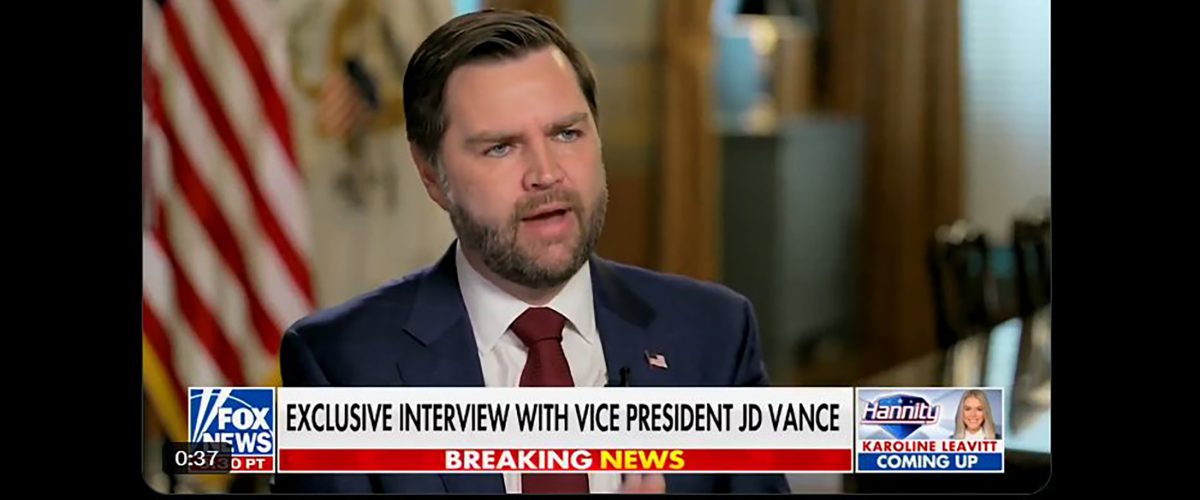
Here is what he said in the interview on the Fox News Channel that has drawn a lot of conversation.
There’s this old school — and I think it’s a very Christian concept, by the way — that you love your family and then you love your neighbor and then you love your community and then you love your fellow citizens and your own country, and then after that you can focus and prioritize the rest of the world.
The feel of his words makes sense at a gut level. I have a greater responsibility to my family than I do to a stranger. To not take care of my family is worse, as Paul said, than an infidel, which would make me guilty of infidelity, and the root of infidelity is fides, which is faith. Not taking care of my family is not keeping the faith. The greatest infidelity is to cheat on your spouse, and a man who cheats on his spouse should never be trusted with anything truly important for he has proven himself faithless.
But I digress. I nearly let this blog post get hijacked by another topic.
There is an order to my responsibilities: family, church, community, nation, and ultimately the whole world. I don’t think anyone, Christian or otherwise, would argue the Veep is right about this basic order of responsibility. So he’s right about that.
But there are problems with what he said. The first is his use of love. This is where Professor Lewis would remind us love in English has many different contours best expressed by the four words for love in Greek. Aside from that, Jesus very famously proclaimed the greatest commandment (Matthew 22:34-40) is to love God and love our neighbor as ourself. There is, therefore only a two-pronged hierarchy with The Lord at the top and then our neighbor, whom Jesus defines as anyone who needs help (see the Parable of the Good Samaritan, Luke 10:25-37). Jesus never taught and the Bible never hints at any kind of ‘family, neighbor, community, citizens, world’ ordered love.
Now, of course I love my sprouts with a stronger and deeper commitment than I do the teenage boy who bagged my groceries yesterday. It’s not even close. But the way Vice President Vance spoke on the issue was to use an ordered love hierarchy as a wedge. The Vice President sees a world whereby I only have to love the boy who bagged my groceries after I have shown love to my daughters with all the love I have and then only care about the bag boy if I have anything left over.
Such an understanding of love inverts our baseline model for love, which is God himself. He spared not his own son because he loved the whole world (John 3:16).
If I can put a big bow-tie on it, to love The Lord and love the world is to raise my daughters to know they have a responsibility to serve and protect the people of this world, because some of them need people to help and advocate for them. I create greedy, spoiled brats if I teach my daughters they only have to love their neighbors with their leftovers because we all know there will never be any leftovers. And we create a greedy, spoiled brat society if we teach our country to only take care of your own at the expense of everyone else. If I know anything about Americans it is we are the most generous, benevolent, and empathetic people on the planet and this is precisely because the gospel is saturated into our social psyche whether most people are aware of it or not.
My feelings for my daughters are greater than those for the grocery bagger. Yet, it is wrong to use those intense feelings to say the bag boy is far down the list of people I have to care about so, practically, he doesn’t matter and I shouldn’t feel too bad about it anyway because of the orders of love. Love, and neighbor love, has no order. It moves from the hands and feet of the body of Christ to the whole world without prejudice.
I don’t know if the Vice President is intentionally trying to twist the gospel into a, ‘I will only take care the orphan, widow, or immigrant, sick, beaten traveler on the side of the road after I have made sure everything else is okay’ because if he is, then he is turning the Levite and Priest who did nothing in the parable as the most virtuous because they were probably on their way home to love their family. Vance’s line of thought leads to a violation of the biblical gospel and takes the practitioner into a false gospel of selfish narcissism.
The second problem, though, with this is how Vice President Vance so brazenly pronounced what Christian doctrine is as though he were the keeper of the faith. I am not aware of any doctrine that even remotely sounds like what he said other than perhaps what a football coach might say as a slogan, ‘God, family, country’ kind of thing. People in government have a lot of power to do a lot of things, but defining Christian doctrine is not one of them, and defining it as if it were a completed, settled, universally understood idea is even worse. Very few things in our faith are that clearly defined. Vance is a Roman Catholic and I am a Baptist. We probably have very different viewpoints of what Christianity is all about.
Again, I want to be perfectly clear; I am not even saying here that the overarching point of Vance’s argument is wrong. In many ways he is absolutely right about civics because the American government should always put the American people first. What I object to is dragging Jesus into it as if Jesus would not 100% want us to be concerned and caring with empathy toward all the hurts of the world. The church is not the government, and the United States is not the chosen people of God. Conflating the two is dangerous for it makes one serve the other.